What is this about?
One road. Two houses of prayer. For years, one of them got the tickets.
The road
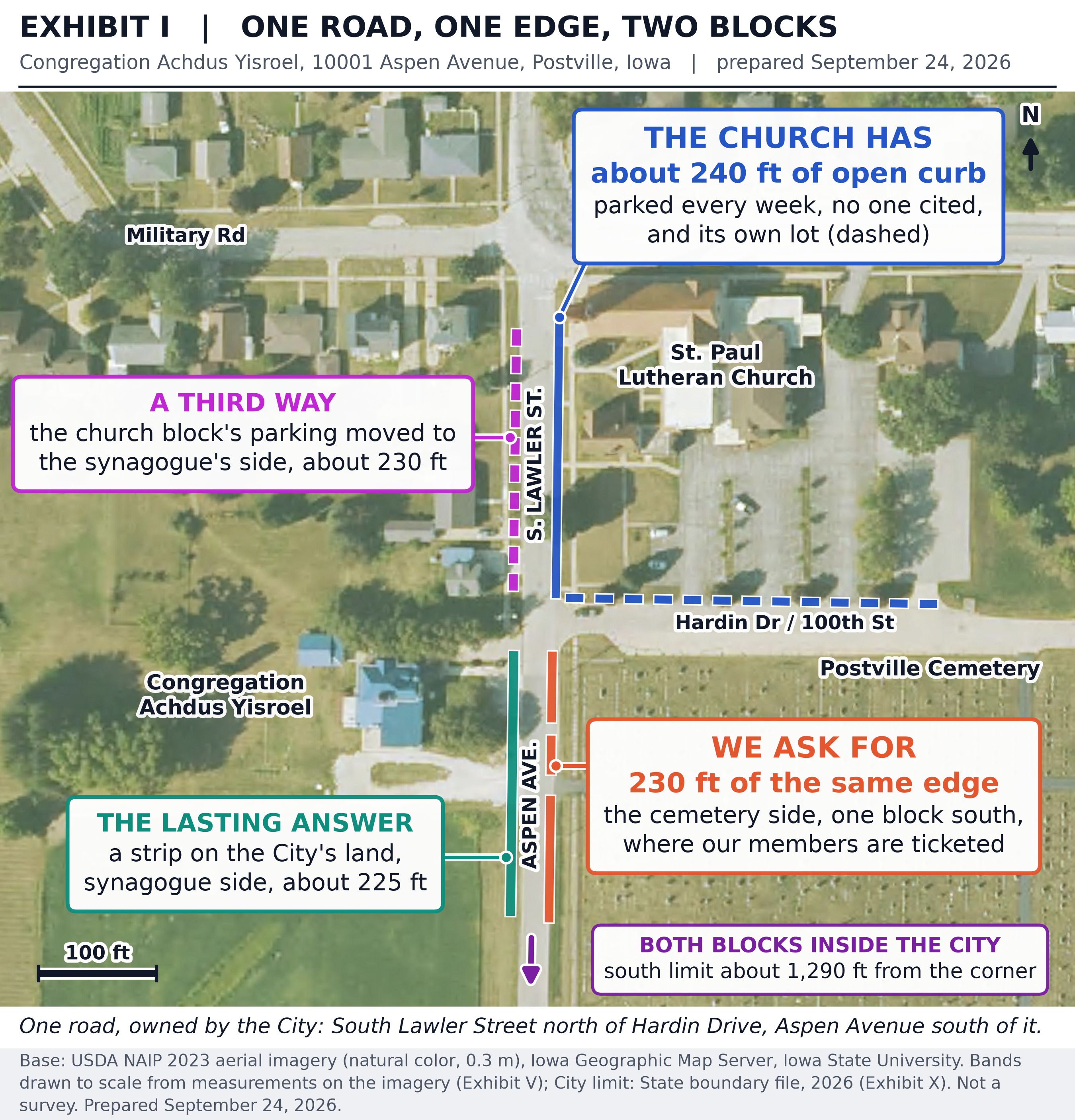
In Postville there is one road. At one end stands St. Paul Lutheran Church. One block south, on the same road, stands our synagogue, Congregation Achdus Yisroel.
The City owns the road. By our own measurement, it is 31.25 feet wide in front of both buildings. The Iowa Department of Transportation's road inventory lists 30 feet for the church's block, and 26 feet for the block by the cemetery, where our synagogue stands. We plan to ask an independent professional to measure it. Until October 12, 2026, the City's rulebook, the City Code, said nothing against parking by day at either block. By our reading, the rules were the same.
At the church
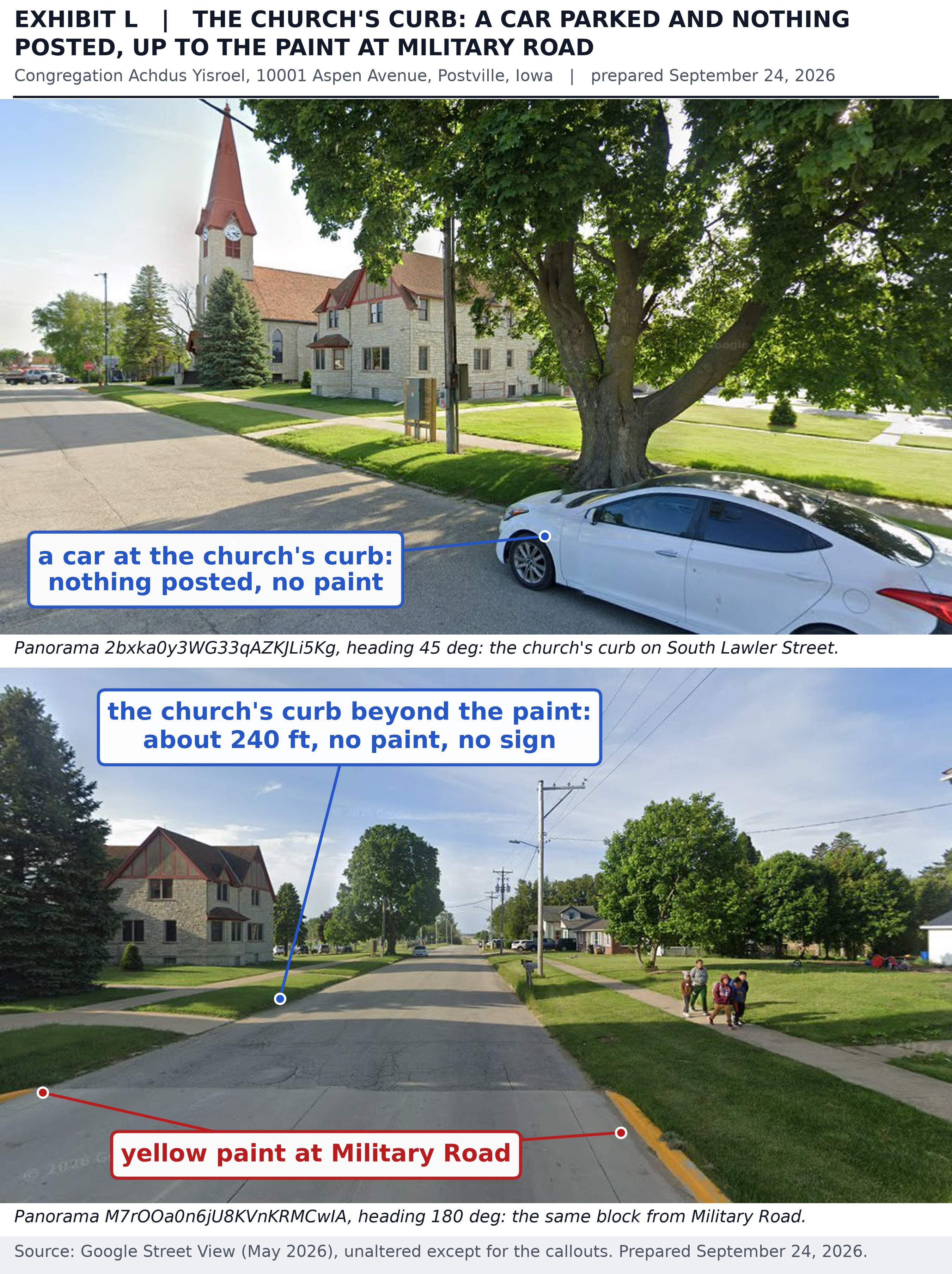
Cars park along the edge of the road in front of the church. About 240 feet of it, by our measurement. Every week. No sign. No paint. No tickets. The church also has its own parking lot.
At the synagogue
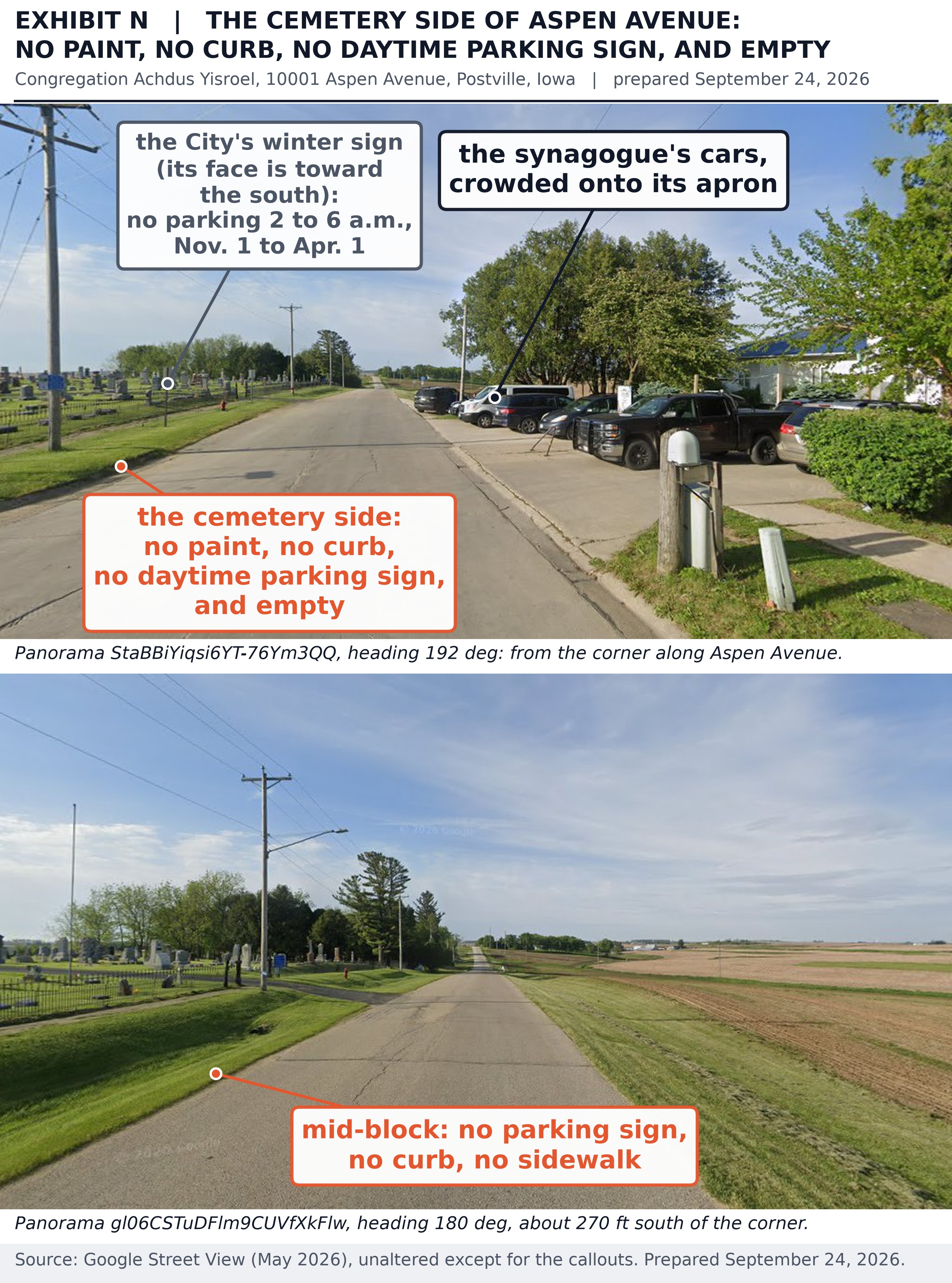
One block south, at the same edge of the same road, our members parked to come and pray. They got tickets. Year after year.
Until October 12, 2026, there was no sign against parking there by day. There was no paint. The Council had never voted to close it. Only the Council can.
We asked for less than the church has
We asked the City for 230 feet of that edge. The church has about 240 feet, by our measurement, and a lot. The City said no. Its letter said that parking "at another location on Lawler Street" does not require it to allow parking at ours. That is the same road, one block up. The church's block.
The reason we were given for years
For years, the only reason we heard was farm machinery. Nobody ever put it in writing.
The machinery comes twice a year, at planting and at harvest. The tickets come all year. In winter the machinery does not come at all. The tickets do. And the machinery drives through the church's block too, past the parked cars, and nobody gives it a thought.
On October 12, 2026, reasons were given out loud at the Council table, on the City's own video: farm traffic, complaints, and the width of the road. The machinery came up again: "these farmers have very big equipment."
When the Council wanted to close one curb on Walnut Drive, it gave its reason on the record: a blind spot where the road turns. That was on May 12, 2025. It sent the question to the City Attorney. It passed an ordinance on June 9, 2025. Twenty-eight days. For our edge, for years, there was no ordinance, no vote, and no record. Only tickets.
What the tickets do to us
For close to thirty years, as our members remember it, we parked in the school's lot behind the synagogue. That ended. Now our members park up the road, on the church's block. By our measurement, the first space is about 200 feet from our door, and the tenth is about 400.
We pray three times a day. That is six walks a day. Close to half a mile. Across a road the City set at 35 miles an hour. With no sidewalk. Our children make that walk. Our parents make it. Members on walkers make it. After dark, too.
For one person who parks at the tenth space, that comes to about 136 miles of walking a year. The arithmetic is on the record page.
In September 2000 the City Council set the limit on our block at 35 miles per hour, by Ordinance 546-00, four votes to one. The newspaper reported that the council member who voted no felt it should stay at 25. A proposal for 25 miles per hour "when children are present," made after concern about the children at the yeshiva school on Aspen Avenue, is not in the ordinance as printed. Iowa law lets a city set its own speed limit on a street like this only on the basis of an engineering and traffic investigation. We have looked for that study. We have not found one. We have asked the City for it.

Even on Yom Kippur, the holiest day of our year, when our law does not let us touch a car, a member came out after a day of fasting and found a ticket.
A member with a disability placard parked off the road, on the synagogue's own concrete, because there was nowhere else. That member came out of prayer to find an officer writing a ticket.
The City has provided parking, at one time or another, for a pickleball court, a park, a clinic, a pharmacy, a child-care center, a Catholic church, and a mosque. We have found no record that it ever marked one accessible space at our door.
The City's own records show it:
- Paving for a parking lot at the pickleball court, approved March 10, 2025.
- Paving for a City parking area at 201 South Boody Street, approved June 9, 2025.
- A parking lot at Lull's Park, paid for on October 13, 2025.
- A handicap parking area across from the medical clinic, approved June 13, 2022.
- A space in the City lot for the pharmacy only, approved October 14, 2024.
- Three ten-minute spaces in front of the child learning center, in the City Code since at least 2010.
- Angle parking along the blocks of the Catholic church and the mosque, in the City Code since at least 2010.
The signs
Walk around our building. More than five tow-away signs stand on every side of it. Whoever put each one there, we have driven the streets of Postville looking for others. We could not find two around any other building, or one in front of any other house of worship. What message would you take from that?
It is not fair
Turn it around. Imagine it was your church that got the tickets, and the synagogue one block up that parked free, at the same edge of the same road, under the same rules. What would you call it?
We have looked hard for another reason. We could not find one. The City's letter of September 23 named none. One congregation is Christian. The other is Jewish. I believe that is what this is about. A court will decide whether I am right.
First, this is a matter of simple decency. Then it is the law, and the Constitution: equal treatment for everyone, and the free exercise of religion. Equal treatment is not a favor. It is the law.
This has happened to Jewish communities in other places too. Other cases, other facts. Nothing here predicts this one.
What we did
We asked. We asked again. Then we wrote. We measured the road, took the photographs, read the City's Code and its minutes back to 2021, and put all of it in front of the City.
On September 23, 2026, the City said no. On September 24 we answered with everything you see here, and asked once more. We asked for an answer by October 5. None came. We asked for the matter to be on the Council's agenda for October 12. It was not. Our letters were not mentioned that night.
What happened on October 12, 2026
Two things happened at the Council's meeting that night that concern us. Both are on the City's own video of the meeting.
First, the Council heard a challenge to a $20 parking ticket. The ticket was written on September 21, 2026. That was Yom Kippur. It was written at the corner by our synagogue. The Council voted to dismiss it.
Second, the Council passed Ordinance #716-26, a change to the City's parking rules. It voted five to zero. Then it voted to waive the remaining readings, so the ordinance passed that same night. The City has not posted the written text yet. Until it does, here is how the change was described at the meeting, on the City's video:
- The road is a farm-to-market road, "which means ag has priority."
- Starting "at the curve right at the church," there will be "no parking on either side of the street," all the way down the road to where the City's pavement ends.
- "That means even the synagogue."
- If the church has a funeral or a wedding, the City will "put out cones."
- Asked why now, the answer was that the City gets complaints, and "this office does not react until it gets a complaint."
- Someone at the table asked whether any "less restrictive alternatives" had been considered. The answer was: "I don't think so." It was said that there "just isn't enough road width there."
- "The only parking that's going to be available is on Cemetery Road," which is Hardin Drive. Asked what is in front of the synagogue, the answer was: "The boulevard."
Before the vote, a Council member suggested adding handicap parking near the corner. We do not know yet whether the final text includes it. When the City posts the text, we will post it here, in full.
The City's Code allows parking on a residential boulevard only "on paved area at an authorized curb cut." On June 13, 2022, the Council approved "the parking lot curb cut request at 10001 Aspen Avenue," five to zero. That is our synagogue's address. The minutes do not say where on our property that curb cut is, and we claim no more than they say.
In our own words: our community built four parking spaces beside the synagogue, on the synagogue's own ground, with our own labor, our own money, and our own cement. A photograph of them will be added here. Even so, we have never been allowed to park on the boulevard in front of our door.
As it was described on the City's video, the road at our door will be closed to parking on both sides. The church has its own parking lot, and the City said it will put out cones for its funerals and weddings. Our own concrete holds only a few cars. We pray there three times a day.
Watch the meeting yourself. The ticket starts at 6 minutes and 43 seconds. The ordinance starts at 51 minutes and 19 seconds. Then judge for yourself.
[Button: Watch the City's video]
The City owns the ground at our door. We believed one memo would end the tickets. We still believe one strip of pavement would end the walk. The City chose tickets. On October 12, as described on its own video, it chose a ban on both sides of the road.
What this case seeks
This case is not mainly about money. We asked the City for parking, not money, and we offered to withdraw everything if it simply took care of us. If the City ends up paying, that will be its own doing.
Two things. The road put right, so no one crosses it to pray. And the damages the law allows for years of unequal treatment, which a jury decides.
It is also about accountability. The people responsible for this practice should not go on making these decisions for the City.
The City of Postville carries liability insurance, through a pool of Iowa cities, as its own audits show. Whether it pays is decided at the end. It costs you nothing to register. The plan is for the attorneys to be paid only from what the case wins, and that will be confirmed in writing before anyone signs. Nobody can promise a result, and we do not.
The door is still open
Even now, before any case is filed, the door is open. If the City will sit down with us, provide proper parking, lower the speed on our road, and end this treatment, the community's leadership will sign a release. The exact terms will be settled when the City sits down with us. That is the leadership's position. Your own rights stay your own. No one can sign them away for you.
Why this website
This did not happen to one person. It happened to everyone who ever came to the synagogue and made that walk, or paid that ticket, or looked at those signs. That is why this case is a class action: one case, for all of us.
If you were affected, or you saw it, register below and tell your story. Everything you tell us after you register goes to the attorney's office, and nowhere else. It does not go to the City.
Gideon Gratsiani For and on behalf of the Jewish Community of Postville, Iowa
[ I was affected ] [ I have information that can help ]
Neighbors, see for yourself, and help us stop this.
Know something? Tell the attorneys in confidence.
[Close]